
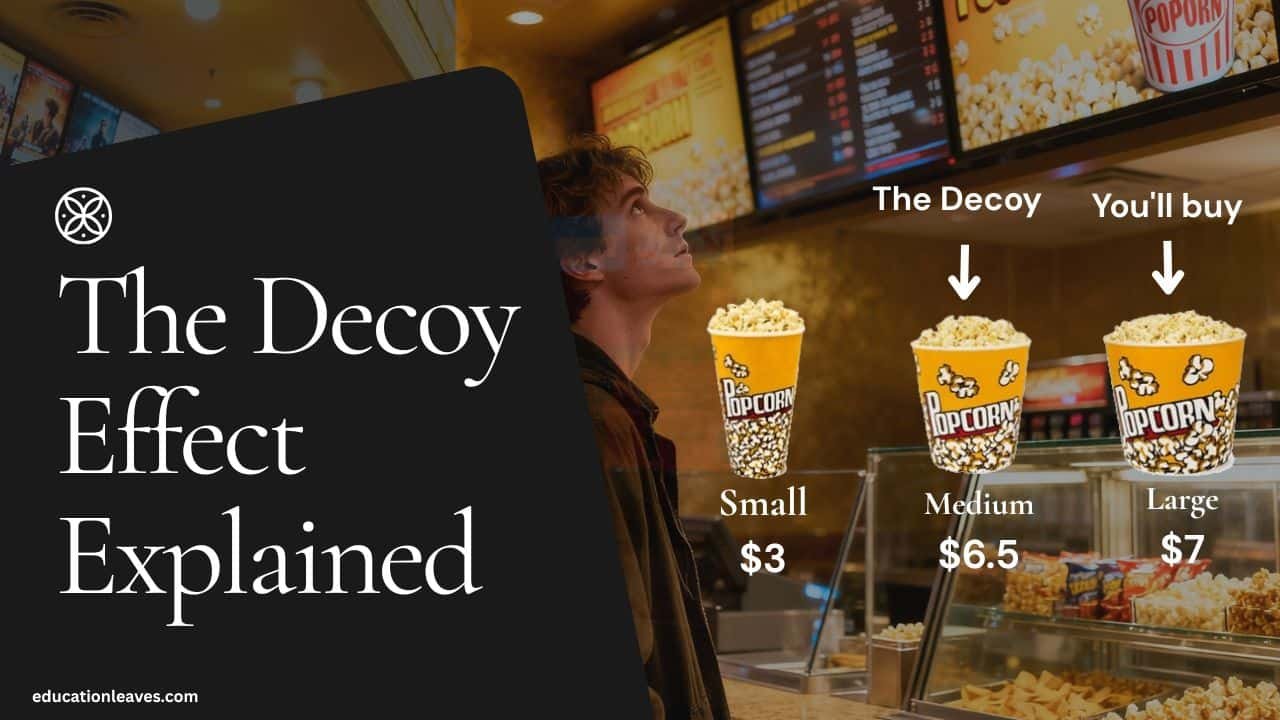
Picture this: You’re at a movie theater, eyeing the popcorn menu. Small for $3, large for $7. You lean toward the small until you spot the medium at $6.50. Suddenly, that large seems like a steal. You’ve just fallen victim to the decoy effect, one of behavioural economics’ most powerful phenomena.
This psychological pricing trick isn’t accidental; it’s a carefully crafted strategy that businesses use billions of times daily to influence consumer behaviour. Understanding how it works can save you money and help you make truly rational decisions.
What you are going to learn?
What Is the Decoy Effect?
The decoy effect, also known as the asymmetric dominance effect, occurs when introducing a third, strategically inferior option changes our preference between two original choices. This “decoy” is designed to be completely dominated by one option (the target) while only partially dominated by the other (the competitor). The result? We gravitate toward the target, feeling smart about our “obvious” choice.
The beauty of this tactic lies in its subtlety. You don’t feel manipulated; you feel empowered, believing you’ve discovered an exceptional deal through your own clever comparison shopping.
The Classic Case Study: The Economist Subscription Experiment
Behavioural economist Dan Ariely famously studied this phenomenon using The Economist’s actual subscription pricing. When Ariely received a subscription offer from the magazine, he noticed they offered three plans:
- Internet-only for $59
- Print-only for $125
- Print-and-Internet for $125
Who would choose the print-only option when the combo costs exactly the same? Ariely tested it with 100 MIT students—some of the world’s brightest minds. The results were telling: 16% chose the Internet-only option, 0% chose the print-only option, and 84% selected the print-and-Internet combo deal.
But here’s the kicker: when Ariely removed the print-only option entirely, the results flipped dramatically. Now 68% chose the cheaper web-only option, while only 32% picked the combo. The “useless” print-only option wasn’t useless at all; it was a masterful decoy that made the combo appear irresistibly valuable.
This experiment revealed a profound truth about human psychology: the mere presence of an option we never intend to choose can dramatically alter our preferences among the remaining options.
Why Our Brains Fall for the Decoy Effect
The Comparative Mind
The decoy effect exploits a fundamental trait in human decision-making: we struggle to evaluate options in isolation. Instead, we rely on comparisons to determine value. Psychologists refer to this as “relative thinking,” and it’s hardwired into our cognitive processes.
When you see a $50 shirt next to a $200 shirt, the $50 option suddenly seems inexpensive, even if it would have felt pricey on its own. Our brains constantly search for reference points to anchor our judgments.
Decision Fatigue and Cognitive Shortcuts
When faced with complex trade-offs between price and features, our brains seek the path of least resistance. The decoy provides an easy reference point, making one choice appear obviously superior. This shortcut helps us avoid the mental exhaustion of carefully weighing every variable.
Think about it: Would you rather spend 20 minutes calculating the per-ounce value of three popcorn sizes, or simply notice that the large is “only 50 cents more” than the medium? Your brain prefers the latter.
The Dominance Principle
Humans are attracted to options that clearly dominate others. When Option A beats Option B on every measurable dimension, choosing A feels logical and safe. Decoys exploit this by creating an inferior option that makes the target choice appear dominant, even when it might not be the best choice for your actual needs.
Real-World Applications: Where You Encounter Decoys Daily
Technology and Electronics
Apple has mastered the decoy effect with iPhone storage tiers. Consider a typical pricing structure:
- 128GB model: $799
- 256GB model: $899
- 512GB model: $999
The 256GB option often serves as a decoy, making the 512GB model seem like only “$100 more for double the storage.” Many consumers who initially planned to buy the base model end up with the premium version, spending $200 more than intended.
Similarly, laptop manufacturers strategically price configurations to nudge customers toward models with higher profit margins. That mid-tier option with slightly better specs at a disproportionate price increase? That’s your decoy.
Streaming Services and Subscriptions
Netflix, Spotify, Hulu, and countless other streaming platforms position their “standard” plans as the sweet spot between basic and premium tiers. The basic plan often has just enough limitations (lower video quality, limited screens, ads) to feel restrictive, while the premium plan seems unnecessarily expensive—unless you compare it to the middle option.
The standard plan becomes the “Goldilocks choice”—not too cheap, not too expensive, just right. But is it right for you, or just right for the company’s revenue goals?
Restaurant Menus and Wine Lists
Ever noticed how restaurant wine lists often include a few extremely expensive bottles? These aren’t there because restaurants expect to sell them regularly. They’re there to make the $60 bottle seem reasonable compared to the $300 option.
Menu design experts use decoy dishes strategically. That overpriced steak isn’t meant to be ordered frequently; it’s there to make the restaurant’s signature dishes seem reasonably priced by comparison.
Real Estate and Car Sales
Realtors occasionally show potential buyers properties slightly outside their budget range or with obvious flaws. These “decoy properties” make the property the agent really wants to sell appear more attractive. Similarly, car dealerships display premium models to make mid-range vehicles seem like practical compromises.
Software and SaaS Products
Business software companies frequently offer three pricing tiers, with the middle tier containing most of the essential features plus a few premium perks. The basic tier is deliberately limited, while the enterprise tier is priced for large organizations. The result? Most small to medium businesses choose the middle option, which typically has the highest profit margin.
The Psychology Behind Pricing Strategies
Anchoring Effect
The decoy effect often works in tandem with anchoring, where the first number we see influences our perception of subsequent prices. By presenting a high-priced option first, businesses anchor your expectations upward, making lower prices seem more reasonable.
Loss Aversion
Humans hate losing out on value more than they enjoy gaining it. Decoys exploit this by making us feel we’re “losing” the extra features or quantity if we don’t choose the target option. That medium popcorn makes you feel like you’re leaving money on the table if you don’t upgrade to the large.
The Compromise Effect
People often gravitate toward middle options, perceiving them as safe compromises between extremes. Businesses design their pricing to position their most profitable option as this middle ground, even if it’s objectively overpriced for what you actually need.
How to Recognise and Resist the Decoy Effect
Identify Your Needs Before Shopping
Before looking at options, write down exactly what you need. If you need 64GB of phone storage, don’t let a 512GB decoy convince you otherwise. Knowing your requirements in advance immunises you against comparison-based manipulation.
Calculate True Value
Do the math. What’s the per-unit cost? How much are you actually using? If you stream movies once a week, do you really need 4K ultra HD on four simultaneous screens? Often, the “best value” is only valuable if you actually use what you’re paying for.
Cover the Decoy
Literally. When comparing options, try covering or ignoring the middle option and re-evaluating the others. Does your preference change? If so, you were likely influenced by the decoy.
Ask “Would I Choose This If It Were Alone?”
Remove the context of comparison. If someone offered you just the large popcorn for $7 without showing you other sizes, would you buy it? This mental exercise helps reveal whether you genuinely want something or just want it relative to the alternatives presented.
Beware of “Just” Thinking
Phrases like “It’s just $2 more” or “It’s only $100 more” are red flags. Those small increments add up, and they’re designed to make upgrades seem trivial. Evaluate each dollar as if it matters—because it does.
Set a Budget and Stick to It
Before encountering options, decide your maximum spend. If you’ve allocated $5 for popcorn, the large at $7 isn’t a good deal, regardless of how it compares to the medium. Budget discipline defeats psychological pricing tricks.
The Ethical Debate: Manipulation or Smart Marketing?
Is the decoy effect ethical? This question divides economists, marketers, and consumer advocates.
The Case for Decoys: Proponents argue that businesses have the right to present their offerings however they choose, and consumers ultimately make voluntary decisions. Nobody forces you to buy the large popcorn. Additionally, decoys can actually help overwhelmed consumers make decisions more easily by providing clear reference points.
The Case Against: Critics contend that deliberately exploiting cognitive biases crosses the line from persuasion to manipulation. When businesses intentionally design offerings not to be purchased but solely to influence other purchases, they’re not providing genuine choices but manufactured illusions of choice.
The truth likely lies somewhere in between. While consumers should take responsibility for their decisions, businesses also have an obligation not to exploit psychological vulnerabilities predatorily.
Decoy Effect in Marketing: A Business Perspective
For entrepreneurs and marketers reading this, understanding the decoy effect can dramatically improve pricing strategy. Here’s how to implement it ethically:
Design With the Customer Journey in Mind
Create pricing tiers that genuinely reflect different customer segments and needs. Your decoy should guide uncertain customers toward the best fit, not trick everyone into overpaying.
Test and Iterate
Use A/B testing to see how different pricing structures affect conversions and customer satisfaction. The goal should be long-term customer value, not short-term revenue spikes from manipulated purchases.
Maintain Value Integrity
Ensure all your offerings provide genuine value. If customers feel deceived after purchase, you’ll lose their trust and business. The decoy effect should clarify value, not obscure it.
Be Transparent
Consider explaining your pricing logic. Some companies have found that transparency about why they price as they do actually increases trust and conversions.
Beyond Pricing: The Decoy Effect in Other Decisions
The decoy effect extends far beyond commercial transactions. It influences:
Political Choices: Third-party candidates can act as decoys, drawing votes disproportionately from one major candidate.
Career Decisions: When considering job offers, an unattractive third option can make one of the others seem clearly superior, even if neither is ideal.
Relationship Choices: Dating apps and our social circles sometimes present “comparison options” that make certain potential partners appear more attractive.
Health Decisions: Medical treatment options presented with a clearly inferior third choice can push patients toward specific treatments.
Recognising this pattern across life domains helps you make more autonomous decisions aligned with your genuine preferences rather than relative comparisons.
The Future of Pricing Psychology
As consumers become more sophisticated and aware of psychological pricing tactics, businesses are evolving their approaches. Dynamic pricing algorithms now adjust decoys in real-time based on individual browsing behaviour and demographic data. Artificial intelligence can identify which specific decoys work best for different customer segments.
This arms race between consumer awareness and marketing sophistication will likely continue. The best defence remains the same: self-awareness, critical thinking, and discipline in sticking to pre-determined needs and budgets.
The Takeaway: Empowerment Through Awareness
Understanding the decoy effect empowers you as a consumer to recognize when your choices are being influenced. Next time you encounter three options, ask yourself: Is that middle choice truly there to be chosen, or is it there to make you choose something else entirely?
Remember these key principles:
- Pause before purchasing. Give yourself time to evaluate options without the pressure of immediate decision-making.
- Focus on your actual needs, not on which option seems like the best deal relative to others.
- Do the math. Calculate real value rather than perceived value.
- Question why options are structured the way they are. If something seems designed to lead you toward a specific choice, it probably is.
The decoy effect isn’t going away—it’s too effective and too deeply embedded in modern pricing strategies. But with awareness and discipline, you can make choices based on what you genuinely want and need rather than what clever pricing structures suggest you should want.
In the end, the goal isn’t to never fall for psychological pricing tactics. We’re all human, and our brains work the way they work. The goal is to fall for them less often, to catch ourselves when we can, and to make decisions that align with our authentic priorities rather than manufactured comparisons.
The next time you’re standing at that movie theater counter, you’ll know exactly what’s happening. And maybe, just maybe, you’ll walk away with the small popcorn and $4 still in your pocket—unless, of course, you genuinely wanted the large all along.
Download The Decoy Effect PDF
FAQs for Decoy Effect
What is an example of a decoy effect?
A coffee shop offers a small latte for $3 and a large for $5.50. When they add a medium for $5, most customers suddenly choose the large; it feels like a bargain for “just 50 cents more.” That medium option? It’s a decoy designed to make the large seem irresistible, even though you originally planned to buy the small.
How to Use the Decoy Effect
For Consumers (Avoid Being Manipulated)
Before shopping, write down exactly what you need and set a firm budget. When faced with three options, cover the middle one and see if your preference changes—if it does, you’ve spotted the decoy. Always calculate the actual per-unit value and ask yourself: “Would I choose this if it were the only option available?”
For Business Owners (Implement Ethically)
Create three pricing tiers where your target option clearly beats a strategically weaker decoy on every measure, while your basic option trades features for savings. Price the decoy close enough to your target that customers think “for just a bit more, I get way more value,” then test different structures to see what resonates. Remember, the decoy should guide customers to the best fit for their needs, not trick them into overspending—satisfied customers return, manipulated ones don’t.
Quick Implementation Formula
Step 1: Identify which product or tier you want most customers to choose (your target). Step 2: Create a decoy that’s clearly worse than your target but only slightly worse than your basic option—think same price as the target but fewer features, or nearly the same price as basic with barely any upgrades. Step 3: Test and refine based on real customer behavior, ensuring all options deliver genuine value so you build long-term trust, not short-term sales.
What is a Decoy in Psychology?
In psychology, a decoy is an intentionally unattractive option introduced to influence your decision between two other choices. It’s strategically designed to be clearly inferior to one option (making that option look like the obvious winner) while only partially worse than the other. Think of it as a psychological puppet master; it’s not there to be chosen, but to control what you do choose by shifting your perception of value through comparison.
Why is the decoy effect so powerful?
The decoy effect is powerful because it hijacks how our brains naturally make decisions, through comparison rather than careful analysis. When we see three options, we instinctively look for the “obvious winner” instead of asking what we actually need, making us feel smart about a choice that was engineered for us. It’s essentially invisible persuasion that makes manipulation feel like discovery.
5 Essential Cognitive Biases That Shape Your Decisions
1. Confirmation Bias
We naturally seek out information that confirms what we already believe while ignoring evidence that contradicts our views. This is why two people can look at the same facts and reach completely opposite conclusions—each focuses only on data that supports their existing worldview.
2. Anchoring Bias
The first number or piece of information we encounter heavily influences all subsequent judgments, even when it’s irrelevant. If a car is initially priced at $30,000 then reduced to $22,000, that anchor makes the final price feel like a bargain, even if the car is only worth $18,000.
3. Availability Heuristic
We judge how likely something is based on how easily we can recall examples, not actual statistics. People fear plane crashes more than car accidents because plane crashes get massive media coverage, even though you’re far more likely to die driving to the airport than flying.
4. Loss Aversion
Losing $100 feels roughly twice as painful as gaining $100 feels good, which makes us irrationally avoid losses even when taking risks would benefit us. This is why people hold onto losing investments too long, hoping to “break even,” rather than cutting their losses and moving on.
5. Dunning-Kruger Effect
People with limited knowledge in a field tend to vastly overestimate their competence, while experts often underestimate theirs. That person confidently arguing about climate science after reading two blog posts genuinely believes they understand it as well as scientists who’ve studied it for decades, because they don’t know enough to recognise what they don’t know.
What is another name for the Decoy Effect?
The decoy effect is also widely known as the asymmetric dominance effect in academic circles, referring to how one option asymmetrically dominates the decoy while the competitor doesn’t. Some researchers and marketers also call it the attraction effect, since the strategically placed inferior option attracts customers toward a specific target choice.
You might occasionally hear it described as phantom decoy pricing in business contexts, though this term is less common in formal literature.
What is the Decoy Effect in relationships?
In dating, the decoy effect happens when someone introduces you to a less appealing third option to make another person seem more attractive by comparison. Your friend might bring along their awkward coworker to a group hangout specifically to make their other single friend shine brighter, or dating apps strategically show you profiles that make certain matches appear more desirable than they actually are.
This psychological trick manipulates your romantic choices the same way pricing menus do: through strategic comparison rather than letting you evaluate each person on their own merits.
What is a decoy person example?
A decoy person is a fake individual used to trick or mislead someone, often in security or investigative contexts. For example, undercover police might use a decoy hitch-hiker at the roadside to catch criminals who stop with bad intentions, or cybersecurity teams create fake user accounts called “honey users” with names like “Finance_Admin” to lure hackers into revealing themselves when they attempt unauthorised access. These decoys appear genuine to the target but are strategically placed to detect threats, gather intelligence, or prevent harm to real people and assets.
Can the decoy effect backfire?
Yes, the decoy effect can backfire when customers recognise the manipulation, leading to trust erosion and negative brand associations. If the decoy feels too obvious or inauthentic, sophisticated consumers may perceive it as deceptive, which triggers buyer’s remorse and damages long-term customer relationships. Research shows this is particularly risky in markets with repeat buyers who notice patterns over time, creating pricing fatigue and the sense that they’re being exploited rather than served.
What is the function of a decoy?
A decoy’s function is to lure attention away from the real target by presenting a convincing but fake option or object. It is used to mislead, distract, or confuse others so the true goal, asset, or choice stays protected or looks more attractive.